WHAM! – LEICESTER, 1984. Updated October 2026
It’s Friday 31 August 1984. Leicester City are preparing to travel to Highfield Road to face Midlands rivals Coventry City the following afternoon.
But for a group of young Leicester supporters known as the Baby Squad, there’s a whole night to get through first.
In the pubs and nightclubs of Leicester city centre, celebrated photographer Steve Pyke MBE and writer Chris Burkham find themselves among one of Britain’s emerging football casual groups. It’s a world of designer sportswear, expensive trainers, elaborate hairstyles, tattoos, bravado and fierce loyalties.

The photographs that emerged from that evening provide an extraordinary record of British youth culture in the 1980s. Beyond the reputations and headlines, Pyke captures something more intimate: the clothes, friendships, characters and everyday details of a generation whose identity was closely connected to football.
Four decades later, the photographs remain as compelling as ever.
Leicester City’s Baby Squad and the Rise of Football Casuals
The Leicester City Baby Squad emerged around the late 1970s and early 1980s, as football casual culture began spreading across Britain.
Groups of young supporters were increasingly adopting expensive European sportswear and designer clothing in place of traditional football colours. Fashion became a form of identification, competition and status, with particular labels, trainers and styles carrying meaning among those who knew.
The Baby Squad developed a reputation as one of the Midlands’ football firms, associated with the rivalries and violence that characterised part of the terrace scene during this period.
But, as with the wider casual movement, clothing and personal style played an important role in the group’s identity.


The fashion was deliberate. Looking right mattered.
Burberry, Aquascutum, Fiorucci jeans and Yves Saint Laurent clothing were among the labels worn by those Pyke encountered in Leicester.
It was a world in which the latest fashions could mean as much as a club scarf, and the streets, pubs and nightclubs provided their own stages for being seen.
The Baby Squad’s story belongs to the wider history of British football casual culture – a movement whose influence would extend far beyond the terraces into music, fashion and mainstream British youth culture.
Steve Pyke: A Friday Night in Leicester, 1984
Rather than documenting the Baby Squad during a football match, Steve Pyke followed the group through Leicester’s nightlife.
The evening unfolded across a series of familiar city-centre venues, beginning at the Corn Exchange public house before moving to Mr Kaisa’s nightclub and, later, Topps.
In his accompanying account, Chris Burkham describes a charged atmosphere of loud music, drinking, boasting, deals being made and preparations for the following day’s fixture.
The Baby Squad were young, sometimes barely old enough to be drinking, but they carried themselves with the confidence and bravado of an established group.
Pyke’s photographs bring those descriptions vividly to life.
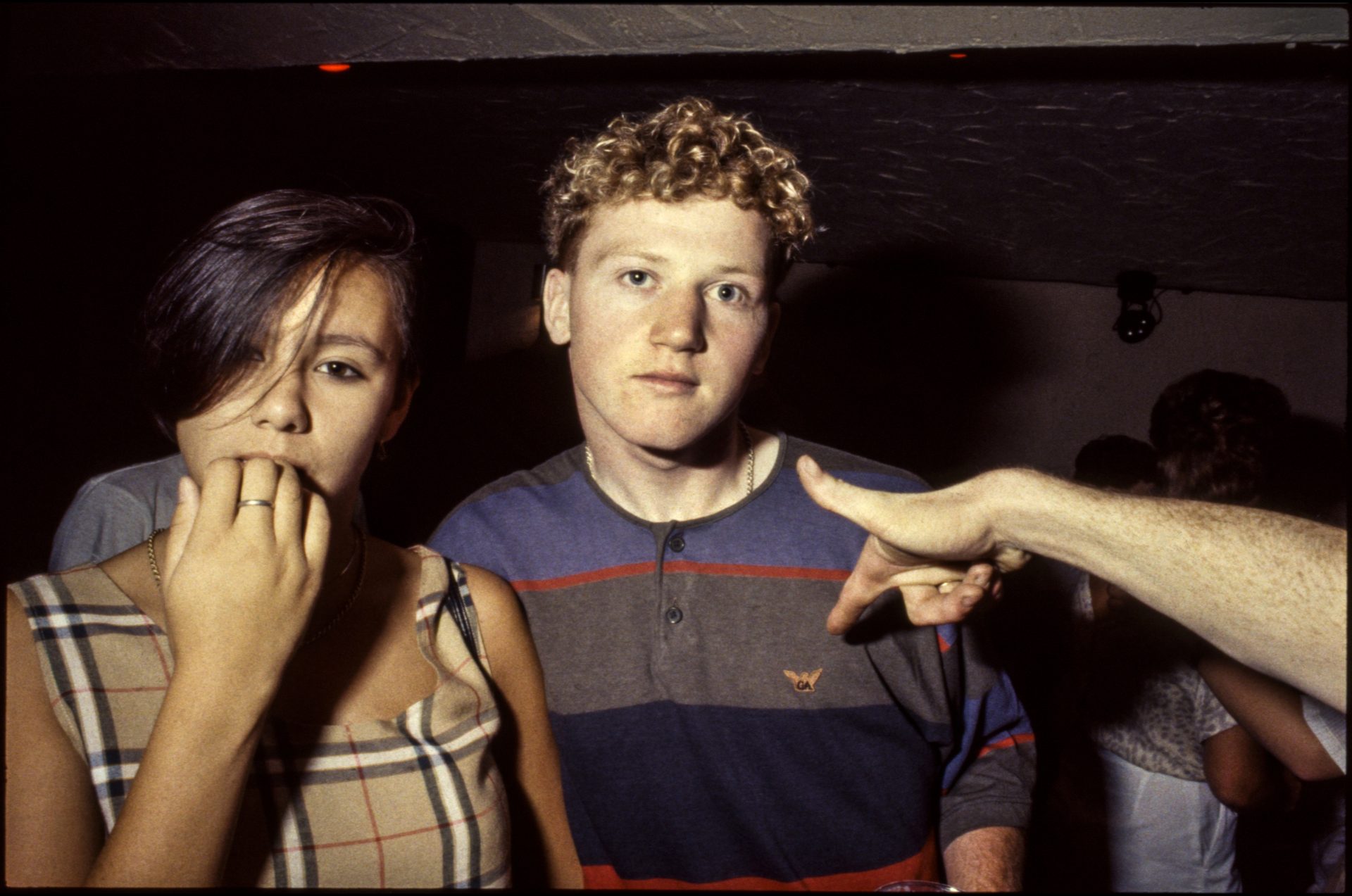
There are carefully chosen outfits, distinctive hairstyles, young men posing for the camera, girls enjoying a night out, and groups of friends caught between conversation, dancing and the occasional confrontation.
The photographer’s proximity to his subjects is crucial. These aren’t distant observations of anonymous football supporters. Pyke is right there among them, recording their expressions, gestures and relationships.
The results feel immediate and spontaneous – a remarkably intimate portrait of Leicester nightlife in the mid-1980s.
Choose Wham! – Football, Fashion and Pop Culture
One of the most striking details from the evening comes at Topps nightclub.
Among the Baby Squad are young men wearing matching T-shirts bearing the slogan CHOOSE WHAM!, a reference to one of Britain’s biggest pop acts of the period.


The shirts, according to Burkham, had been taken from a city-centre shop earlier that afternoon.
They were intended to provide a collective appearance for the following day’s journey to Coventry, helping the group evade police detection and blend in while remaining recognisable to one another.
It’s an extraordinary detail, reflecting the unlikely meeting of football casual culture and mainstream 1980s pop music.
Inside the clubs, Frankie Goes to Hollywood and Chaka Khan provide the soundtrack. On the streets, designer sportswear and carefully chosen clothing signal another kind of identity.
Football, fashion, music and youth culture existed alongside one another, sometimes in unexpected combinations.
Pyke’s photographs capture that collision with remarkable honesty.
The matching Wham! T-shirts, the drinks, the hairstyles and the dancefloor scenes tell us as much about Britain in 1984 as they do about Leicester City’s supporters.
The Girls Were There Too
The presence of young women throughout Pyke’s photographs is particularly significant.
Much of the history of football casual culture has been told through the experiences of men, especially the football firms that dominated newspaper coverage.
Yet women were part of the wider social world surrounding the terraces, contributing to its fashion, music and identity.

Several of Pyke’s photographs reveal that broader picture: groups of young men and women sharing the same nightclubs, social circles and changing fashions.
One of the photographs from the Baby Squad series has recently found a new audience through its appearance on the cover of So, What Were The Girls Wearing?!, a book by Roo Oxley exploring the experiences and overlooked history of female football casuals.
Published in September 2026, Oxley’s book examines the role women played within casual culture, challenging the idea that the movement was exclusively male.
The connection offers another reason to revisit Pyke’s photographs.
They preserve details of an era that have too often been lost or overshadowed by the more sensational aspects of football’s past.
Chris Burkham: The Night Before Coventry
The photographs are accompanied by a vivid first-hand account from Chris Burkham, who joined Pyke for the evening.
His writing captures the atmosphere, language and personalities of the night, including the tension between the Baby Squad and the city’s nightclub security.
Burkham’s account is an uncompromising portrait of its time. Alongside the humour, fashion and youthful energy are references to theft, violence and the uncertainty facing some of the young people involved.
At Topps, as the evening reaches its climax, Burkham writes:
“The air is alive with sexual tension, heavy with the smell of cheap scent.”
But the account is also concerned with identity, place and belonging. For many of those involved, Leicester City was something that helped define who they were and where they came from.
Burkham closes his recollection with a reminder of the seemingly small details that survive in memory:
“The Foxes, and stolen Wham! T-shirts, and lager-tops, and Pernod-and-blacks for the girls.”
The following afternoon, Leicester City lost 2–0 to Coventry City at Highfield Road.
The match result has long since become a footnote. The photographs and memories of the previous evening have endured.
Chris Burkham’s complete first-hand account is published alongside Steve Pyke’s photographs in the Lower Block Edition Baby Squad 1984.
Baby Squad 1984 – Preserving an Important Photographic Archive
More than forty years after they were taken, Steve Pyke’s photographs remain an important record of British football and youth culture.
Their significance lies not only in the reputation of the Baby Squad, but in everything surrounding it: the clothing, music, friendships, city nightlife and personal identities of the young people photographed.


Many of the subjects will now be grandparents. The fashions have changed, the venues have disappeared or been transformed, and football itself is almost unrecognisable from the game they followed.
Yet the photographs retain an extraordinary sense of immediacy.
Published by Lower Block, Baby Squad 1984 brings together 17 colour photographs by Steve Pyke across 32 pages, accompanied by Chris Burkham’s complete account of the evening.
The A5 photographic Edition preserves a distinctive chapter in the history of Leicester City, British football casuals and the culture of the 1980s.
Explore Baby Squad 1984 – photography by Steve Pyke MBE, words by Chris Burkham.

Baby Squad 1984 | Steve Pyke
A series of photographs by Steve Pyke that follow the Leicester City Baby Squad on a night out in 1984.
A limited edition A5 zine containing 17 colour photographs across 32 pages.
Suggested Lower Block Editions

More from the Lower Block Archive